Navigating the Goods and Services Tax (GST) in India can be daunting for both new business owners and everyday consumers. Since its inception, the GST council has periodically revised the tax slabs to ensure fairness, boost revenue, and provide relief to consumers on essential items.
In this comprehensive guide, we'll break down the latest GST rate structure and what falls under each tax slab following the most recent amendments.
The Broad Structure of GST Slabs (GST 2.0)
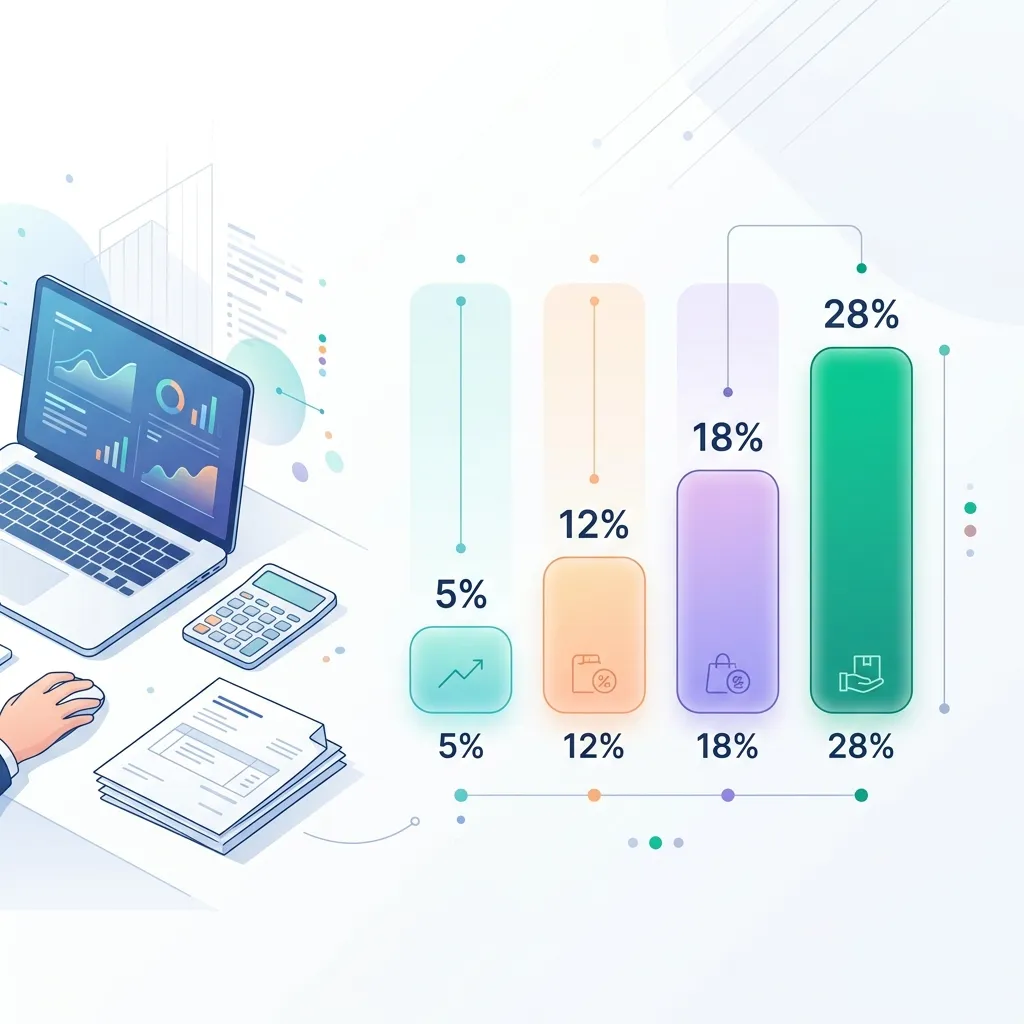
With the introduction of the landmark GST 2.0 reforms (effective late 2025), the Indian GST system has been vastly simplified into four primary tax slabs: 0%, 5%, 18%, and 40%. The legacy 12% and 28% brackets have been largely merged or eliminated to reduce compliance complexity.
Here is a quick overview:
| GST Rate | Category | Examples |
|---|---|---|
| 0% | Exempt / Essential | Fresh food, unbranded flour, life-saving medicines, individual health insurance |
| 5% | Merit Rate / Mass Consumption | Packaged food, daily essentials (soap, toothpaste), kitchen utensils |
| 18% | Standard Rate | Consumer electronics, household appliances, motorcycles, small cars, IT services |
| 40% | Luxury / Demerit | Luxury vehicles, tobacco, pan masala, aerated beverages |
[!NOTE] Precious stones and metals maintain special rates. For example, gold and silver are still taxed at 3%, ensuring continuity for the jewelry sector.
Detailed Breakdown by Slab
1. The 0% Slab (Exempt Goods & Services)
To protect citizens and ensure food security and health, basic necessities remain completely exempt.
- Goods: Fresh milk, eggs, vegetables, fruits, bread, salt, and life-saving medicines.
- Services: Educational services, basic banking, and notably under the new reforms, individual health and life insurance premiums.
2. The 5% Slab (Merit Rate)
Items widely consumed by the masses that involve some level of processing or packaging are taxed at the lowest positive tier.
- Goods: Dairy products (butter, cheese, ghee), packaged foods (namkeen), hair oil, toothpaste, and soap.
- Services: Small restaurants and economy transport services.
3. The 18% Slab (The New Standard Rate)
In the GST 2.0 era, the previous 12% and 18% slabs were merged into a single standard 18% rate. The vast majority of consumer goods and professional services now fall here.
- Goods: Mobile phones, consumer electronics, household appliances, motorcycles, and small cars.
- Services: IT services, financial services, telecom services, and professional B2B consulting.
4. The 40% Slab (Luxury and Sin Goods)
Replacing the old 28% slab (and its complex cess structure), the flat 40% rate is strictly applied to luxury items and demerit goods.
- Goods: High-end luxury vehicles, tobacco products, cigarettes, pan masala, and caffeinated/aerated beverages.
- Services: High-end casino gambling and exclusive luxury hospitality.
Recent Amendments & Changes
The GST Council meets regularly to review and adjust these rates. Recent notable amendments have focused on:
- Rationalization of IT Hardware: Adjustments to the rates of computer parts and peripherals to boost domestic manufacturing.
- Online Gaming: A highly debated move finalized the GST on online gaming, casinos, and horse racing at a flat 28% on the full face value of bets.
- Green Energy Relief: Tax reductions on EV charging stations and critical components for renewable energy setups to promote sustainability.
Get Pinbooks updates in your inbox
Join Pinbooks for free to get the latest insights on business and taxation.
Conclusion
Understanding the correct GST slab for your products or services is crucial for compliance and pricing strategy. Applying the wrong rate can lead to severe penalties, loss of input tax credit (ITC), and unhappy customers. Always consult with a registered Chartered Accountant or use verified GST billing software like Pinbooks to ensure your invoices are 100% compliant with the latest rules.
Quick tip: Use our free GST Calculator to instantly compute CGST, SGST and IGST on any amount.